
How to Survive a Long-Haul Flight With a Baby: 2026 UK Guide
By BabyTravel UK Editorial Team · Last updated September 2026
A long-haul flight with a baby is the hardest single thing most travelling parents will do. Not because anything goes badly wrong — most of the time it doesn't — but because 10 hours in an economy seat with a small person who cannot understand why they're there, cannot sleep on demand, and cannot be reasoned with is genuinely exhausting. Thousands of UK families do it every year. Most do it again. The destination has to justify the flight, but if it does, the flight is survivable — and the strategies here will make it considerably less awful.
This guide is specifically about long-haul (6+ hours) from the UK — the airlines UK families actually fly with, the bassinet system, the shift strategy, the entertainment marathon, and the 2am stretch of ocean where everyone questions their decision-making. For your first flight or a shorter trip, our first flight guide covers the general principles.
Quick Answer: Long-Haul With a Baby
- 🛏️ Get the bassinet seat — request it at booking, confirm at check-in. It changes the experience entirely for babies under 10kg.
- 🌙 Book a night flight if you can — your baby may sleep for 6–8 hours of it if you time bedtime correctly.
- 👥 Take shifts if you're a couple — one parent owns the baby for 3–4 hours while the other actually rests. Swap. Arrive functional.
- 🎒 Your hand luggage is a toybox — reveal toys one at a time every 30–45 minutes. Never show everything at once.
- ✈️ Best airlines for UK families: Qatar, Emirates, and Singapore Airlines consistently lead on baby facilities and crew attitude.
Is Long-Haul With a Baby Realistic?
Honest answer: yes, but it's hard. You will have a 2–3 hour stretch somewhere in the middle of the night where you question every decision you've ever made. Your baby will not sleep for the full flight. There will be a point where you've exhausted every toy, every snack, and every tactic you brought, and the map screen still shows two hours to go.
But here's the counterpoint: millions of babies fly long-haul every year without incident. The flight is a finite, bounded experience — it ends. What waits on the other side (Dubai's beaches, Thailand's warmth, New York, Australia, wherever you're headed) is the reason you booked. If the destination genuinely justifies it, the flight is worth it. Make sure it does before you commit.
The approach that makes long-haul manageable is preparation rather than improvisation. Every section of this guide is about reducing the number of moments where you're improvising at 3am over the Indian Ocean.
The Bassinet: The Most Important Thing on a Long-Haul Flight
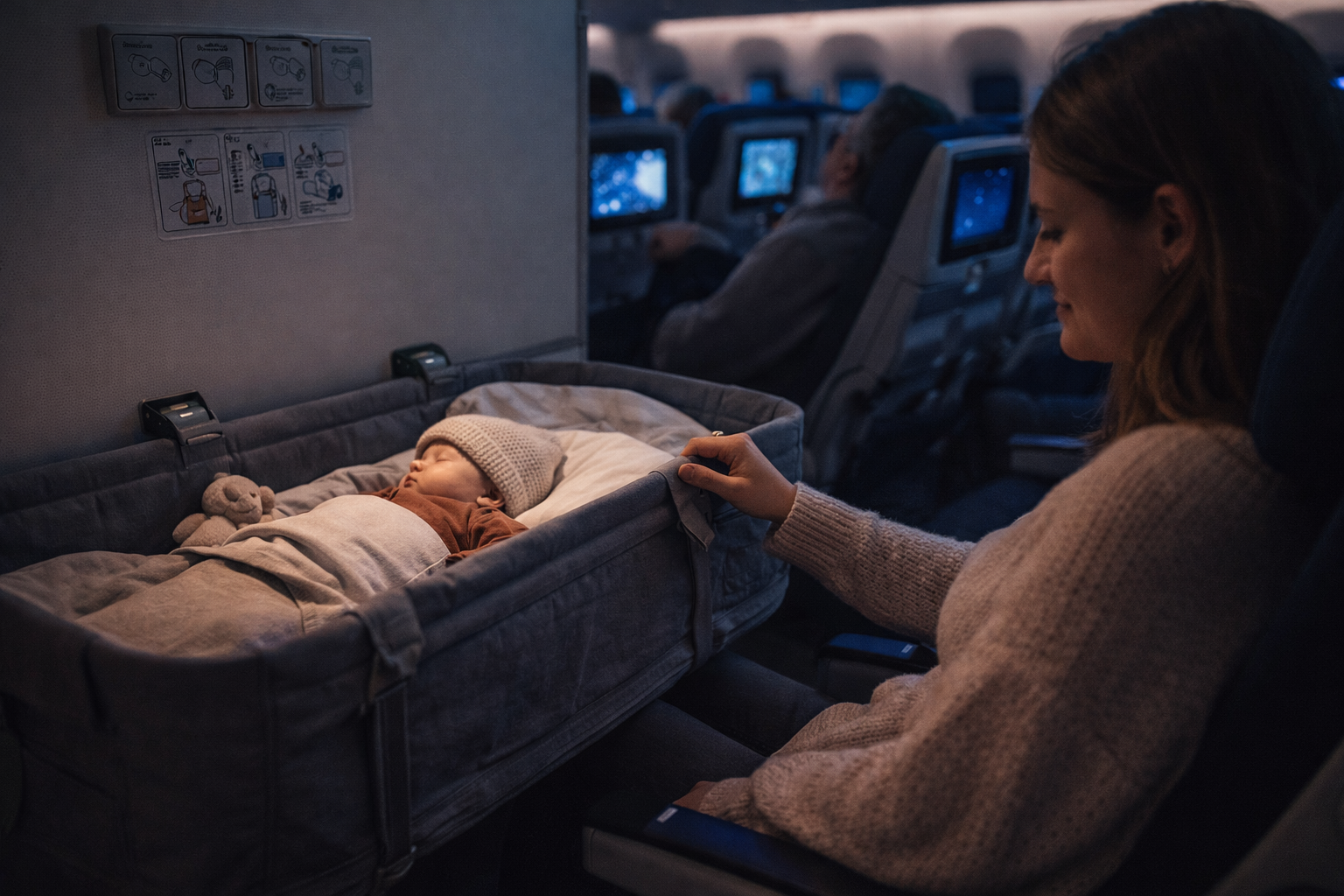
If you have a baby under the weight limit, getting a bassinet seat is the single most important thing you can do. The bassinet is a fold-down crib attached to the bulkhead (front wall of the cabin section), which means your baby has somewhere to lie flat and sleep that isn't on you. For a 10-hour flight, the difference between having a bassinet and not having one is enormous.
How to Get One
Request a bassinet seat at the time of booking — most airlines have a specific process for this, either during the booking flow or by calling the airline after booking. Do not leave it until check-in. Bassinet seats are in high demand and allocated on a first-come, first-served basis at many airlines. Once you've requested it, confirm again at online check-in and again at the airport desk.
You will be allocated a bulkhead row, which means extra legroom but also no seat pocket in front of you (because there's no seat). All your baby kit needs to go in the overhead locker when you're seated, which means planning your hand luggage so the essentials are accessible without constant locker raids.
The Bassinet in Practice
The airline bassinet is a metal-framed, fabric-lined crib that folds down from the bulkhead wall. It's firm rather than soft, which is fine — a firm, flat surface is actually safer for sleeping babies. The mattress pad is thin; bring a fitted sheet from home if you want a familiar surface for your baby. The bassinet must be stowed during takeoff, landing, and whenever the seatbelt sign is on — which means the baby comes back to you during turbulence.
Weight limits vary by airline but typically run to 10–11kg (roughly 9–12 months, depending on your baby's build). Once your baby is mobile — rolling, sitting, pulling up — the bassinet becomes harder to use even within the weight limit, because they won't stay lying down. The bassinet is most effective for babies under about 6–7 months.
| Airline | Bassinet Weight Limit | Baby Meal Available | Changing Facilities | Our Rating |
|---|---|---|---|---|
| Emirates | Up to 11kg / 2 years | Yes (pre-order) | Dedicated changing area | ⭐⭐⭐⭐⭐ |
| Qatar Airways | Up to 11kg / 2 years | Yes (pre-order) | Dedicated changing area | ⭐⭐⭐⭐⭐ |
| Singapore Airlines | Up to 11kg / 2 years | Yes (pre-order) | Fold-down table in lavatories | ⭐⭐⭐⭐⭐ |
| Virgin Atlantic | Up to 10kg / 6 months | Yes (pre-order) | Changing table in lavatories | ⭐⭐⭐⭐ |
| British Airways | Up to 11kg / 2 years | Yes (pre-order) | Changing table in lavatories | ⭐⭐⭐⭐ |
| Turkish Airlines | Up to 11kg / 2 years | Yes (pre-order) | Changing table in lavatories | ⭐⭐⭐⭐ |
Always confirm bassinet availability and current weight/age limits directly with your airline before booking — policies update regularly.
The UK Airlines: What to Expect
📋 Free Baby Holiday Packing Checklist
Enter your email and we'll send the free printable checklist straight to your inbox — every category, ready to tick off before every trip.
Emirates is consistently the favourite for UK families flying long-haul. The ICE entertainment system, the crew attitude towards families, and the Dubai hub (which makes our Dubai with a baby guide worth reading as a destination in itself) make it a natural first choice for many routes. The bassinets are spacious by airline standards and the changing areas on A380 aircraft are genuinely usable.
Qatar Airways earns equally strong reviews for baby handling. The Doha hub is less compelling as a destination than Dubai but the service is excellent and the onward connections are extensive. Strongly recommended for Asia and Australia routes.
Singapore Airlines is the industry benchmark for in-flight service and their baby facilities match that reputation. The flights are long (14+ hours to Singapore from London) but the experience is as good as this category gets. Worth the premium if budget allows.
British Airways is reliable and familiar, with solid baby facilities on long-haul routes, though the fleet is mixed in quality — newer aircraft (A350, newer 777) are considerably better than the older 747 and 767 still in service on some routes. Check which aircraft serves your specific route before booking.
Virgin Atlantic has improved significantly on family-friendliness and the newer A350 fleet is excellent. Their Upper Class bassinet is genuinely outstanding for families who want to spend on the experience, though economy is good too.
Turkish Airlines is worth considering for good-value long-haul via Istanbul, particularly to East Africa, South Asia, and certain US routes. Baby facilities are solid, crew are generally helpful, and the Istanbul layover can be managed comfortably in the terminal.
Sleep Strategy: Getting Your Baby to Sleep on a Long-Haul Flight
The single best thing you can do for long-haul sleep is book a night flight. If the departure time allows your baby to stay roughly on UK bedtime through the first few hours, you can run their full bedtime sequence on the plane — and if you have a bassinet, there's a genuine chance of a 5–7 hour sleep stretch. That transforms a 10-hour flight from an endurance event into something approaching manageable.
Running Bedtime in the Air
Use the same bedtime sequence as home, as closely as possible. Once the seatbelt sign is off after takeoff — usually 20–30 minutes — do the bath equivalent (a warm flannel wipe-down in the lavatory is surprisingly effective), change into pyjamas, feed, read the familiar book, put into the sleeping bag, and settle with familiar sensory cues. Cabin crew will dim the lights for an overnight flight, which helps considerably.
Familiar objects matter a lot here. The sleeping bag, the comforter (if used), and a portable white noise source — the aircraft engine noise is actually useful background noise and helps some babies sleep better than at home, but a dedicated sound machine clips to the bassinet and ensures consistency. See our holiday routine guide for the full approach to maintaining sleep sequences away from home.
For a toddler with their own seat, a comfort device can support the legs during cruise, but airline rules vary sharply: compare our toddler airplane beds and airline restrictions before buying. A genuine CARES child aviation harness is a restraint rather than a bed, while a ride-on suitcase must still fit the booked cabin-bag allowance.
Managing Wakeful Hours
There will be wakeful hours. On a 10-hour flight, plan for 3–4 hours of your baby being awake and needing active engagement. Walking the aisles is remarkably effective — the combination of movement and changing scenery settles most babies. The galley areas at the back of the plane are a good refuge: crew are often there, there's space to stand and rock, and you won't disturb sleeping passengers. Make friends with the cabin crew early — they will often hold your baby for 5 minutes while you eat, and their willingness to do so is worth more than any toy you packed.
The Parent Shift Strategy
If you're travelling as a couple, take shifts. This is non-negotiable on anything over 8 hours. One parent "owns" the baby for 3–4 hours — feeds, changes, settling, aisles walking, everything. The other parent sleeps, reads, watches films, and actually rests. Then swap. Both parents arrive at the destination having had some sleep and some time off. Neither arrives completely destroyed.
The shift handover is important: agree the timing before departure so there's no negotiation at 2am. "You take 10pm–2am, I'll take 2am–6am" removes the decision-making from the hardest part of the journey.
If you're flying solo with a baby, acknowledge now that sleep is probably not happening for you on the flight. Book a night flight so the baby has the best chance of sleeping, ask for help from crew freely and without guilt, position yourself in the aisle seat for maximum mobility, and pack a seat-back organiser so everything is accessible without disruption. The solo long-haul is the hardest version of this — plan extra recovery time on arrival.
Pro Tip: The Secret Weapon Toy
Pack one completely new toy that your baby has never seen before — the "secret weapon." Save it for the hardest stretch of the flight (usually hours 6–8 on a 10-hour overnight, when the baby has been awake for 2 hours and everyone is exhausted). A novel toy buys 20–30 minutes of genuine engagement. It's the most reliable tactic on this list.
Entertainment for 8+ Hours
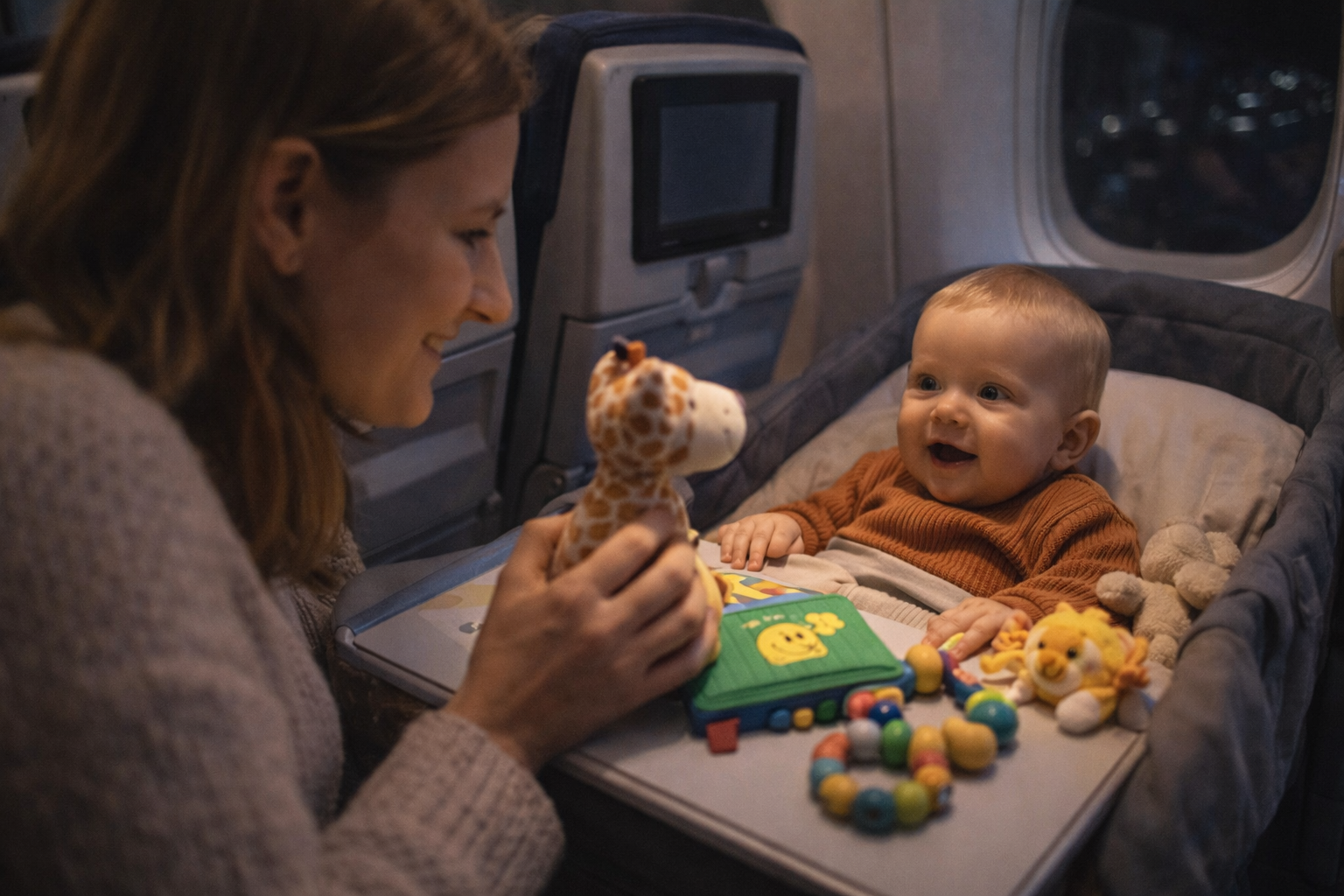
Your hand luggage is a toybox and you are its curator. The rotation principle is everything: never show all your toys at once. Reveal one item every 30–45 minutes, keep the rest hidden. The moment your baby sees everything available, the novelty is gone and nothing works. Timed reveals extend engagement dramatically. If you need fresh ideas before you pack, our roundup of the best travel toys for babies and toddlers is worth a look.
What to Pack for In-Flight Entertainment
- 3–4 small, tactile toys the baby loves at home — familiar and engaging
- 1 brand-new toy never seen before — save for the hard stretch
- Board books — lightweight, safe, familiar, rereadable
- Sticker books — for babies 12 months+ who are into peeling and placing
- Snack rotation — a different snack every 45–60 minutes functions as entertainment as much as nourishment
- Tablet with downloaded content — for babies 12 months and older, pre-download everything. Never rely on in-flight Wi-Fi or streaming. CBeebies app and downloaded episodes of a favourite show are gold from 2am onwards.
- A small Tupperware with something to post/pour — posting small pom-poms through a hole, pouring rice between containers — simple sensory play that lasts longer than you'd expect
For the full packing breakdown, our baby hand luggage checklist covers every category with quantities for different flight lengths.
For quick, low-mess ideas you can pull out at a moment's notice, our Busy Bag 5-Minute Challenge Cards give you printable activity prompts designed for flights, queues, and restaurant waits — £4.99 as an instant download.
Nappy Changes on a Long-Haul Flight
Plan for 4–8 changes on a 10-hour flight. Long-haul aircraft are considerably better equipped for this than short-haul — most have dedicated fold-down changing tables in at least one lavatory (usually the larger one at the back of the cabin, marked with a baby symbol). The table is still firm and narrow, but it's functional. Bring a padded travel changing mat — the bare plastic table is cold and hard and your baby will object.
The key is preparation: a dedicated change pouch with everything in it (2 nappies, travel wipes, nappy bags, mat) that comes out as one unit rather than requiring you to excavate your hand luggage while holding a squirming baby over an airplane toilet. The following product is worth its weight in overhead locker space for this reason:

Skip Hop Pronto Changing Station
The airplane lavatory changing table is hard, cold, and often damp. The Pronto folds flat, has a padded surface that's actually comfortable, and has an integrated pocket for wipes and a nappy so your entire change kit comes out in one piece. It clips to the buggy handle in the airport and folds into your bag on the plane — it covers the full journey.
- ✅ Everything in one unit — padded mat, wipes pocket, nappy slot
- ✅ Folds flat, clips to buggy handle for airport use
- ✅ Padded surface is far kinder than bare airplane plastic
- ✅ Machine washable
- ❌ Modest size — suits smaller babies better than 12-month+ wrigglers
Dispose of nappies in the toilet bin, not the seat-back pocket — this happens more than it should and is not appreciated by the people sitting in that seat for the rest of the flight.
Feeding on a Long-Haul Flight
Breastfeeding is the most convenient long-haul option by a significant margin. No preparation, no temperature concerns, available immediately on demand, and a natural settling tool during the wakeful stretches. Use feeding during takeoff and landing — the sucking motion helps equalise ear pressure.
Bottle feeding: Cabin crew will warm bottles on request — this is a standard service on all major airlines. Bring formula in pre-measured dispensers (not loose in a tin — measuring powder in the dark over a toilet bowl at 30,000 feet is a special kind of misery). Bring enough formula for the full flight plus a 3-hour buffer for delays, and use sealed water from the cabin for making up — cabin crew will provide this. Bring enough ready-made formula pouches for the airport if you can.
Weaning babies: Airline baby meals exist (pre-order when you book) but are inconsistent in quality and may not suit your baby's particular tastes. Always bring your own pouches and finger foods as backup. Pack more than you think you need — 8 hours is a long time and mealtimes are useful entertainment as well as nutrition.
For the full airport and in-flight security picture on carrying baby food and milk, our airport security guide for baby milk covers the current UK rules in detail.
Getting Through the Airport With a Baby
The airport experience before a long-haul flight is a category of challenge in itself — and you'll do it again at the other end, jet-lagged. The key is managing the pushchair handoff efficiently. A travel stroller that folds in seconds at the gate and fits in the overhead locker on smaller connecting aircraft is worth considerably more than a bulkier model on a long-haul day.

Bugaboo Butterfly
For long-haul travel, the airport portion of the journey is almost as demanding as the flight itself. The Butterfly's one-second automatic fold means you're through security and gate-checking without the fumbling that costs time and energy when you have a baby on your hip. Suitable from 6 months to 22kg — it'll cover the years of long-haul travel ahead.
- ✅ One-second fold — essential when you're managing a baby, bags, and a boarding queue
- ✅ Fits in aircraft overhead lockers on many regional jets
- ✅ Large shopping basket fits under-seat bag and a changing bag
- ✅ Smooth, suspension-assisted ride over airport terminal surfaces
- ❌ Premium price — around £550–£600, but high resale value
For the full picture on travelling with your pushchair through airports and gate-checking, our guide to taking a stroller on a plane covers everything — including how to protect it from baggage handling damage on the way home.
The Long-Haul Survival Timeline
Every long-haul flight follows a broadly predictable arc. Knowing what's coming — and having a plan for each phase — removes the improvisation that's most exhausting. This is based on a typical 10-hour overnight flight from the UK.
| Phase | What's Happening | Your Strategy |
|---|---|---|
| Hours 0–2 Boarding & takeoff |
Baby is stimulated by new environment, likely unsettled during taxi and takeoff | Feed during takeoff to manage ear pressure. Don't try to settle to sleep yet — let them experience the novelty first. Get set up: sleeping bag accessible, toys ordered, change kit in seat pocket. |
| Hours 2–4 First play cycle |
Baby is awake and engaged. Lights may still be on. Meal service happening. | Rotate toys slowly — one at a time. First nappy change. Eat your own meal if you can. If this is bedtime by UK time, start winding down: dimmer stimulation, quieter voice, familiar objects. |
| Hours 4–6 Target sleep window |
Cabin lights dimming. If timing is right, this is your sleep window. | Run the bedtime sequence. Sleeping bag on. Settle in the bassinet if weight allows. White noise source on. One parent sleeps now while the other is on duty. Do not rush this — a settled baby is worth 30 minutes of effort. |
| Hours 6–8 The hard stretch |
If baby woke after 2–3 hours of sleep, this is the difficult middle. You're tired. They're tired but won't resettle. | Deploy the secret weapon new toy. Walk the aisles. Visit the galley — crew can help. Snack rotation. Tablet time if 12 months+. Tag the other parent in. This phase always ends. |
| Hours 8–10 Descent prep |
Breakfast service starting. Light increasing. Descent begins around hour 9. | Final nappy change before descent. Prepare bottles/feeds for landing — sucking helps with ear pressure. Repack hand luggage so it can go in the locker for descent. Start mentally preparing for arrival logistics. |
Jet Lag on Arrival
Babies adjust to new time zones faster than adults — typically 1–2 days per hour of time difference, which means a 4-hour time zone (Dubai, East Africa) is sorted in 3–4 days, and an 8-hour difference (Thailand, Maldives) in about a week. Babies under 6 months often barely notice — their circadian rhythms are not yet strongly set.
The most effective approach: use natural light to anchor the new time zone from day one. Get outside in morning light as soon as possible on arrival, keep the room dark at night, and feed/nap on destination time rather than trying to hold UK time. The first night will be rough — accept it as part of the experience and don't try to fight it. Subsequent nights improve quickly.
Don't panic about long-term damage to sleep patterns — a week of disruption does not undo months of sleep training. Going straight back to the home routine on return, from the very first night, is the fastest recovery. Our routine guide covers both the going-away and the coming-home adjustment in detail.
Long-Haul Destinations Worth the Flight
The destinations that consistently justify the flight for UK families with babies: Dubai (short enough at 7 hours, excellent baby infrastructure, guaranteed sunshine), the Maldives (for parents who want genuine relaxation with a water-safe baby), Thailand (Koh Samui and Hua Hin offer resort-style accessibility), Mauritius (more manageable flight at around 11 hours, excellent resorts), and Florida (though 9–10 hours is towards the hard end with a young baby).
Our long-haul destinations guide has the full breakdown by flight time and baby-friendliness. If you're not ready for long-haul yet, our European baby holidays guide covers the best 2–4 hour alternatives.
✈️ Free Baby Hand Luggage Checklist
Never forget the essentials. Enter your email and we'll send the free checklist straight to your inbox — one page, every category, ready before every flight.
FAQ: Long-Haul Flight With a Baby
What is the best age for a baby's first long-haul flight?
There's no single right answer, but many parents find 3–9 months is the sweet spot. Younger than 3 months, you're very early in your parenting journey and the logistics can feel overwhelming. Older than 9–10 months, babies are mobile, resistant to containment, and less likely to sleep in a bassinet. Between 4 and 8 months — fed well, in reasonable routine, not yet crawling — is often when long-haul feels most manageable.
How do I get a bassinet seat on a long-haul flight?
Request it at the time of booking through the airline's seat selection or special assistance process. Confirm again at online check-in and at the airport desk. Do not wait until the gate — bassinet seats are allocated early and the good ones go quickly. Call the airline directly after booking if the online system doesn't have a clear bassinet request option.
Can I take a car seat on a long-haul flight?
Yes, provided it's approved for aircraft use — check our car seat on a plane guide for the detail on which seats qualify and how to use them on board. An approved car seat gives your baby a safer, more comfortable sleeping environment than an airline bassinet for some ages, but it occupies a purchased seat rather than a lap position.
How many nappies should I pack for a long-haul flight?
A minimum of 8–10 for a 10-hour flight, plus 2–3 extra for the airport at each end. Overpack on nappies — they're light, flat, and the cost of running out mid-flight is not worth the weight saving. Pack them in an accessible pouch with wipes and nappy bags so you can change efficiently without digging through your main bag.
What's the best long-haul airline for babies from the UK?
Qatar Airways and Emirates consistently rank highest for the combination of bassinet quality, crew attitude towards families, and on-board facilities. Singapore Airlines is arguably the best overall experience but the flights are very long (14+ hours). For the US, British Airways and Virgin Atlantic are solid choices and the more familiar experience of a UK airline can be reassuring on a first long-haul. We've written full guides to the long-haul airlines UK families most commonly use: Emirates, KLM, Lufthansa, and Turkish Airlines — covering exact bassinet policies, infant fees, baby bag allowances, and booking tips.
Should I book a night flight or a day flight for a long-haul with a baby?
Night flight, almost always. A departure in the evening means your baby's body clock aligns with your usual bedtime on the plane — giving you the best chance of the bassinet sleep stretch that makes a long-haul manageable. Day flights mean a fully awake baby for the majority of the journey. The exception: if you have a very young baby (under 3 months) who sleeps frequently regardless of time of day, a day flight may be equally workable.
How do I manage the flight if I'm travelling alone with my baby?
Book a night flight, request the bassinet, pack an aisle seat so you have maximum mobility, and accept that you will not sleep. Tell the cabin crew at boarding that you're solo — most will actively help, check in on you, and offer to hold the baby during meal service. Keep your setup hyper-organised: a seat-back organiser with everything accessible, no digging in the overhead locker. It's hard, but it's finite — and thousands of solo parents do it every year.
Will a long-haul flight damage my baby's ears?
The pressure changes during ascent and descent can cause discomfort in any passenger's ears, and babies can't clear this themselves. Feeding (breast or bottle) or offering a dummy during takeoff and landing triggers swallowing and yawning, which equalise ear pressure. This is the most effective prevention. If your baby has a cold or active ear infection, consult your GP before flying — congestion significantly worsens in-flight ear pressure issues. See NHS guidance on air travel health for more detail.
You Can Do This
A long-haul flight with a baby is demanding, but it is not the disaster most parents fear before they do it. The hard hours pass. The destination is on the other side. And the second long-haul is always easier than the first — you know what's coming, you know your baby's patterns, and you pack better. If the trip you're planning is worth the journey, it almost always is.