
Renting Baby Gear Abroad vs Bringing Your Own: Item-by-Item Guide (2026)
By BabyTravel UK Editorial Team · Last updated March 2026
Every parent faces this question before travelling abroad with a baby: do I lug the travel cot, highchair, and stroller through the airport, or do I trust that the destination will provide something serviceable? The honest answer is that it depends entirely on the item. Some gear is worth every kilo of carrying effort. Others can safely be rented, borrowed from the hotel, or improvised at the destination. This guide breaks it down item by item so you can make the right call for each piece of kit — not just a blanket "bring everything" or "rent everything."
⚡ Quick Answers
- Always bring: travel cot, car seat (under 12 months), stroller, baby monitor, toys
- Bring a compact version: clip-on highchair (Inglesina Fast) as backup
- Usually safe to rent/use local: highchair, baby bath, bed guard
- Most reliable rental option: dedicated baby gear companies, not hire car desks or hotel freebies
- Is renting cheaper? Rarely for items you'll use every trip — a travel cot rental costs as much as buying one

The Dilemma — Why This Decision Matters
Bringing your own gear means familiar, tested equipment your baby is already used to. The travel cot smells like home. The stroller folds exactly the way you expect it to at 7am outside a café. There are no surprises. The cost is the physical effort of transporting it all — the boot space, the checked bag allowance, the airport logistics.
Renting means arriving light. You step off the plane with cabin bags only, collect your hire car, and the cot is already waiting at your villa. No gate-checking, no oversize bag fees, no stroller arriving on the baggage belt with a cracked wheel. The cost is uncertainty: you don't know exactly what you're getting, and with a baby, uncertainty about sleep equipment in particular has real consequences.
The answer — as with most things in baby travel — is to be selective. There are items where familiarity matters enormously, and items where it barely matters at all. Understanding which is which makes this decision straightforward. For the full gear picture, our holiday packing list covers everything to consider before any trip abroad.
Item-by-Item: Bring or Rent?
📋 Free Baby Holiday Packing Checklist
Enter your email and we'll send the free printable checklist straight to your inbox — every category, ready to tick off before every trip.
Travel Cot — Bring
This is the one item where the answer is unambiguous: bring your own. Baby sleep is the single most important factor in a successful holiday, and it depends partly on familiarity — the same mattress firmness, the same smell, the same dimensions. A rented cot introduces variables you can't preview or control. The mattress may be firmer or softer than your baby is used to. The dimensions may be slightly different, which changes how the sleeping bag sits. The smell is unfamiliar.
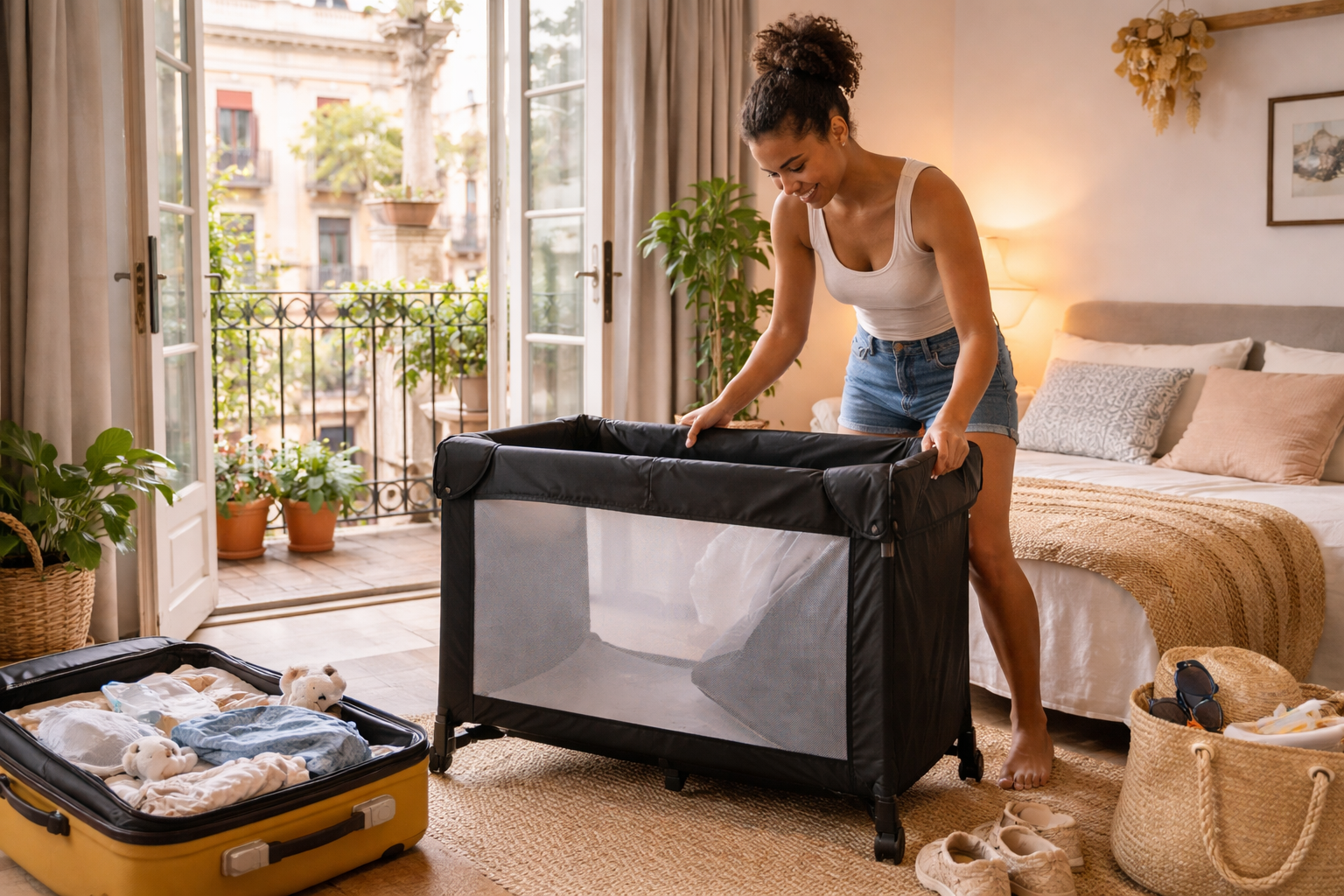
A quality compact travel cot addresses all of this. It folds small enough to fit in a car boot alongside everything else, and the right travel cot sets up in minutes. If you're flying, most airlines allow travel cots as checked luggage within normal allowances.
The one exception: accommodation that explicitly provides a named-brand, current-spec travel cot as standard — some European hotels and villas do this well. In that case, test it on the first night. If baby settles, use it. If not, you'll wish you'd brought your own. Always confirm the brand and spec in writing before arrival — "we have a cot" is not the same thing as a safe, current travel cot.
Safety note on rented cots: If a villa host or Airbnb property provides a cot, ask the brand, model, and age before relying on it. Drop-side cots have been banned in the UK and EU due to infant safety risks — they were common before 2011 and still circulate in holiday accommodation. If the host can't confirm current safety compliance, bring your own. The Lullaby Trust has guidance on travel cot safety worth reading before any trip.
Car Seat — Bring (Under 12 Months), Consider Renting (Toddlers)
For babies under 12 months, bring your own rear-facing car seat. The fit, harness adjustment, and installation method are things you've already mastered — doing this for the first time in a hire car car park in 35°C heat with a tired baby is not the moment to figure out an unfamiliar model. Rear-facing seats also vary significantly in crash protection by brand and model.
For forward-facing toddlers, renting is more defensible — the fit is less critical, and the installation is simpler. But if you do rent from a hire car company, inspect the seat before accepting it: check for visible damage to the shell, test the harness adjustment mechanism, confirm it's the correct group for your child's weight, and make sure all clips and buckles are intact. Reject any seat you're not satisfied with. Hire car companies typically charge €5–€15 per day for a car seat — a week can cost as much as buying your own.
Highchair — Rent / Use Local, Plus Bring a Clip-On
This is the item where renting (or relying on restaurant provision) makes the most sense. Highchairs are bulky to transport, heavy, and most European restaurants have them — the majority of family-friendly destinations are well set up for this. The risk is the occasions where there isn't one: a smaller café, a self-catering accommodation with no highchair, a beach bar with outside seating.
The solution is a portable clip-on highchair. The Inglesina Fast Table Chair clips to almost any solid table, weighs under 2kg, folds flat, and packs into a bag you can carry over your shoulder. It costs around £65–£75 — roughly the same as a week's highchair rental — and you can use it on every trip. Bring this as your backup and you'll never be caught without a safe seat regardless of what the restaurant provides.
Stroller — Bring
Bring your own stroller. You know exactly how it folds, how it steers, where the brake is, and how to fit it in the car boot. A rented stroller introduces all of these as unknowns at the moments you can least afford surprises. Rented pushchairs are also frequently heavy, poorly maintained, and unfamiliar to operate at speed with a tired baby in a busy foreign city.
Gate-checking your stroller is free on most airlines and means it's available from the moment you land. Our guide to packing a stroller for air travel covers the gate-check process and how to protect your pushchair in transit.
Baby Bath — Rent or Improvise
A baby bath is one of the few items where renting — or simply not having one — is genuinely fine. A hotel bathroom sink handles a newborn bath perfectly. A regular bath with a non-slip mat and a hand on baby works for babies who can sit. Most European holiday accommodation has a bath or large shower tray. The baby bath is bulky, rarely offered as a rental item, and almost never worth transporting.
Baby Monitor — Bring
Bring your own monitor. It's light, compact, and essential if baby is sleeping in a separate bedroom while you eat or sit outside in the evening — which describes most self-catering holidays. Rental monitors are rarely available and tend to be dated models with unreliable battery life. Your own monitor is a small item that earns its packing space every night.
Toys and Comfort Objects — Bring
Always bring your own. Familiar comfort objects (a specific soft toy, a muslin, a favourite book) have genuine sleep and settling value that nothing rented or bought at the destination can replicate. Travel toys weigh almost nothing. See our travel toys guide for a curated list of what actually earns its bag space.
Bring vs Rent: Master Reference Table
| Item | Verdict | Reason | Cost to rent (approx.) |
|---|---|---|---|
| Travel cot | ✅ Bring | Sleep depends on familiarity — rented cots are a gamble | €35–€50/week |
| Car seat (under 12 months) | ✅ Bring | Fit and installation are safety-critical at this age | €5–€15/day |
| Car seat (toddler, forward-facing) | ⚠️ Consider renting | More acceptable, but inspect before accepting | €5–€15/day |
| Highchair | ✅ Use local + bring clip-on | Most restaurants provide; clip-on covers gaps | €15–€25/week |
| Stroller | ✅ Bring | You know how to use it; gate-check is free | €30–€60/week |
| Baby bath | 🔄 Improvise | Sink or regular bath works fine; bulky to transport | Rarely available to rent |
| Baby monitor | ✅ Bring | Light, essential for self-catering evenings | Rarely available to rent |
| Bed guard | ✅ Rent or buy locally | Only needed if sharing a bed; cheap to buy at destination | €10–€15/week |
| Toys / comfort objects | ✅ Bring | Familiarity has real settling value; weigh almost nothing | N/A |

Inglesina Fast Table Chair (Portable Clip-On Highchair)
The compact solution that makes renting a highchair unnecessary
At under 2kg and folding flat into its carry bag, the Inglesina Fast is the highchair to pack instead of rent. It clips to any solid table — restaurant, self-catering kitchen, beach bar terrace — and gives you a consistent, familiar seat wherever you are. One purchase covers every trip from 6 months to 15kg, and the weekly hire cost from a baby gear rental company is roughly the same as buying one outright.
- ✅ Clips to almost any solid table surface in seconds
- ✅ Under 2kg — negligible in luggage terms
- ✅ Suitable from 6 months to 15kg
- ✅ Works at self-catering accommodation with no highchair provision
- ❌ Requires a solid table edge — doesn't work on pedestal tables or very thick table tops
Rental Services: What's Actually Available Abroad
Hotel and Resort Provision
Many European hotels — particularly family-focused resorts and four-star properties — provide travel cots and highchairs free of charge on request. Quality varies enormously. At the better end: a named brand travel cot in good condition, freshly made up. At the worse end: a battered cot from 2010 with a thin mattress that arrived 90 minutes after check-in.
Always confirm provision in writing before arrival — ideally specifying the brand. If the hotel can't tell you the brand, that's informative. A quick email before booking asking "what brand of travel cot do you provide?" separates the hotels that genuinely invest in baby facilities from those that have a vague answer on their website.
Dedicated Baby Gear Rental Companies
The most reliable rental option. Companies like the Travelling Baby Company deliver named-brand equipment directly to your accommodation — travel cots, highchairs, strollers, bouncy chairs — and collect at the end of the trip. They typically guarantee cleanliness standards and specific brands, and you can confirm what you're getting before booking.
Typical costs: €30–€50 per week for a travel cot, €15–€30 per week for a highchair, €40–€70 per week for a stroller. For a two-week trip needing multiple items, the costs add up quickly — often exceeding what it would cost to buy a compact version of each item.
Hire Car Companies
Car seats are the main baby gear item available at hire car desks. The quality concern is real: hire car company seats are often older models, maintained to varying standards, and may not be the right size group for your child. At €5–€15 per day, a fortnight's rental can cost £70–£150 — more than buying a decent budget car seat.
If you do rent a hire car seat, inspect it at the desk before accepting: check the shell for cracks, test the harness mechanism, verify it's the correct group for your child's weight, and ensure all buckles click properly. Never accept a seat you're not satisfied with — you're entitled to request a different one.
Airbnb and Villa Hosts
Some hosts list "baby equipment available" as an amenity. This ranges from excellent (a recent travel cot in genuine good condition) to well-intentioned but unsafe (an old drop-side cot from a decade ago). Before relying on host-provided equipment, ask specifically what brand it is and how old. As mentioned above, drop-side cots were banned in the UK and EU due to safety risks — they still exist in holiday accommodation.
| Rental source | Typical items | Cost range | Quality reliability | Booking ease |
|---|---|---|---|---|
| Dedicated rental company | Cots, highchairs, strollers, bouncers | €30–€70/week per item | ⭐⭐⭐⭐ Named brands, cleanliness guaranteed | Book in advance online |
| Hotel / resort | Cot, highchair, sometimes stroller | Usually free on request | ⭐⭐⭐ Varies — confirm brand and condition in writing | Request at booking |
| Hire car company | Car seat only | €5–€15/day | ⭐⭐ Variable — inspect before accepting | Add at booking or desk |
| Airbnb / villa host | Cot, highchair (varies hugely) | Usually free | ⭐ Highly variable — ask brand and age before trusting | Message host before booking |

Graco Compact Travel Cot
The straightforward case for bringing your own
A compact travel cot that does exactly what it needs to: folds flat, fits in a car boot or large checked bag, and sets up quickly in a holiday bedroom. Baby sleeps in the familiar environment they know — same mattress, same dimensions, same smell — and the first-night settling that parents dread when using a rented cot simply isn't an issue. One purchase at around £60–£80 pays for itself compared to two weeks of rental costs on the first trip alone.
- ✅ Compact fold — fits in most car boots and some checked luggage
- ✅ Quick setup — no unfamiliar mechanism to figure out tired at midnight
- ✅ Baby sleeps in a known environment from night one
- ✅ One purchase covers years of holidays
- ❌ Adds weight to your luggage — weigh against the rental cost for flying trips
The Hybrid Approach
The recommendation most experienced travelling parents arrive at is a hybrid: bring the items where familiarity and safety matter most, and rent or use local provision for the items where convenience outweighs familiarity.
Always bring: travel cot, car seat (for under-12-months), stroller, baby monitor, comfort objects, toys, and a clip-on highchair as backup.
Usually fine to rely on local provision: restaurant highchairs (with your clip-on as backup), baby bath, bed guard, and (if you've confirmed brand and condition) a hotel travel cot from a reputable property.
This approach minimises luggage while protecting the essentials. It also means that if something goes wrong with the rented or provided item — the restaurant doesn't have a highchair, the hotel cot is inadequate — you have your own backup for the things that matter most. For how this fits with packing strategy overall, our packing light guide covers the broader approach to minimising what you bring.
Is Renting Actually Cheaper?
Less often than you'd think. A week's travel cot rental at €40–€50 is around £35–£45. A decent compact travel cot costs £50–£100 and lasts three to four years of holidays. By the second trip, you've saved money — and you've eliminated the quality uncertainty every time.
Where renting does make economic sense: items you'd genuinely only use once or twice (a bed guard, a bath seat for a specific age), or items you're unlikely to travel with again after this trip. The hire car seat also makes sense for a single long-haul trip where transporting your own seat is impractical — provided you inspect it carefully at the desk.
For European beach holidays or destinations like Dubai where you might fly, the weight and bag fees deserve to be part of the calculation. A travel cot that adds £30 to your luggage fee on a budget airline shifts the economics. But for driving holidays and most charter flights, the cost of bringing your own remains lower than a week's rental within a trip or two.
✈️ Free Baby Hand Luggage Checklist
Never forget the essentials. Enter your email and we'll send the free checklist straight to your inbox — one page, every category, ready before every flight.
Frequently Asked Questions
Should I bring my own travel cot or rent one abroad?
Bring your own. Baby sleep is too important to gamble on an unknown quantity. A familiar travel cot — same mattress, same smell, same dimensions — removes the biggest variable in first-night holiday settling. A good compact travel cot costs £50–£100 and pays for itself in two trips compared to rental costs. Our travel cots guide covers the best compact options in detail.
Is it safe to use a hire car company's car seat?
For babies under 12 months, bring your own rear-facing seat. For toddlers in forward-facing seats, renting is more acceptable — but inspect the seat before accepting it. Check the shell for damage, test the harness mechanism, and confirm it's the correct group for your child's weight. Never accept a seat you're not confident in.
Do European restaurants provide highchairs?
Most do, but quality and availability vary. A portable clip-on highchair is the practical solution — it covers the occasions where there isn't one, works at self-catering accommodation, and weighs under 2kg. The Inglesina Fast Table Chair (above) is our consistent recommendation for exactly this scenario.
Should I bring my stroller abroad or rent one?
Bring your own. Rented strollers are often heavy, poorly maintained, and unfamiliar to operate. Gate-checking yours is free on most airlines and gives you full confidence throughout the trip. See our stroller on planes guide for the gate-check process and how to protect your pushchair in transit.
Are baby gear rental services reliable abroad?
Dedicated baby gear rental companies are the most reliable option — they deliver named-brand equipment and guarantee cleanliness standards. Hotel provision is variable: always confirm the brand and condition in writing before arrival. Hire car company seats require inspection at the desk. Airbnb "we have a cot" provision is the most unpredictable — always ask brand and age before relying on it.
Is renting baby gear abroad cheaper than bringing your own?
For items you'll use on multiple trips, no. A travel cot rental costs roughly the same as buying one within two to three trips. Where renting makes sense: single-use items (bed guards, bath seats), or a hire car seat for a one-off long-haul trip where transporting your own is genuinely impractical.
What should I check when a villa or Airbnb host says they provide a cot?
Ask the brand, model, and age. Drop-side cots were banned in the UK and EU for safety reasons — they still circulate in holiday accommodation. If the host can't confirm current safety compliance or a recognisable brand name, bring your own. The Lullaby Trust travel cot guidance covers exactly what to look for.
Should I bring a baby monitor abroad?
Yes — it's compact, light, and essential for any self-catering stay where baby sleeps in a separate room while you eat dinner or sit outside. Rental monitors are rarely available and tend to be unreliable. Your own monitor is a small item that earns its space every single night of the holiday.
The Bottom Line
The hybrid approach is the right answer for most families: bring the gear where familiarity and safety matter (travel cot, car seat for young babies, stroller, monitor), and lean on local provision for the rest. The items worth bringing aren't necessarily the heaviest ones — they're the ones that affect sleep, safety, and your ability to function as a parent on day three when everyone is tired. For the full pre-holiday planning picture, see our first holiday guide and the complete holiday packing list.