
Holiday With a 2 Year Old: Toddler Travel Survival Guide (2026)
By BabyTravel UK Editorial Team · Last updated September 2026
Strong opinions, enormous joy, and a complete disregard for your plans. Travelling with a 2 year old is a different game — here's how to play it well.
A holiday with a 2 year old is genuinely different from the baby holidays that preceded it. At this age, your child runs (everywhere, at speed, toward hazards), climbs everything within reach, has a vocabulary expanding by the day, and has discovered the very effective communication tool of lying flat on the floor in a restaurant and screaming. They are also, in equal measure, more fun than they've ever been: properly excited by experiences, delighted by other children, capable of genuine wonder at a sandcastle, a duck, or a particularly interesting stick.
The holiday needs to account for both sides. This guide covers what two-year-olds are actually like for travel, the best types of holiday for this age, managing flights with a toddler who now needs their own seat, tantrums (unavoidable, manageable), sleep, eating out, and the packing list that's genuinely different from what you needed a year ago. For how this compares to earlier ages, see our 18-month travel guide and 9-month travel guide.
Holiday With a 2 Year Old: Key Points
- Flying: most airlines require a paid seat at 2 — no more lap infant
- Best holiday type: holiday parks come into their own (toddler pools, soft play, outdoor space, contained environment)
- Tantrums: they will happen; prevention is better than management; never skip a nap for an activity
- Sleep: one nap (usually after lunch) — protect it fiercely; many 2-year-olds can now climb out of a travel cot
- Entertainment: a tablet with downloaded content is genuinely effective for 20–30 minute stretches at this age
- The upside: beach + sand + water = hours of independent entertainment; they remember and talk about holidays
What Travelling With a 2 Year Old Actually Looks Like
According to NHS developmental guidance, most 2-year-olds are running confidently, beginning to climb, using 50 or more words, and starting to put two or three words together. They understand simple instructions (sometimes choose not to follow them — this is normal). They're interested in other children. They're entering the full imaginative play phase: a stick is a wand, a sandcastle is a castle, a pile of sand is a cake.
The developmental challenge for travel is the combination of mobility, wilfulness, and limited impulse control. A 2-year-old knows exactly what they want, communicates it clearly, and has absolutely no patience for being told no. Add fatigue (which happens fast when routines shift), unfamiliar environments, and sensory overload, and you have the conditions for a meltdown that will happen when you least want it to — at the airport gate, in the restaurant, in the car park outside the beach.
The developmental asset for travel is genuine participation. A 2-year-old gets excited about where they're going. They remember experiences and talk about them ("we saw a BIG fish"). They can walk meaningful distances when they're motivated. They participate in play rather than just observing it. The holiday is starting to be something they experience rather than just something that happens around them.
2 Years vs 18 Months vs 3 Years: The Travel Comparison
📋 Free Baby Holiday Packing Checklist
Enter your email and we'll send the free printable checklist straight to your inbox — every category, ready to tick off before every trip.
| Factor | 18 Months | 2 Years | 3 Years |
|---|---|---|---|
| Mobility | Walking confidently, starting to run | Running, climbing — hard to contain | Running fast, jumping, some balance |
| Communication | 10–20 words. Big frustration gap. | 50–200+ words. Expresses wants clearly. | Full sentences. Negotiation begins. |
| Tantrums | Frequent and intense — peak tantrum age | Regular but decreasing — shorter duration | Less frequent — more reasoning possible |
| Sleep | 1–2 naps. Usually still in travel cot. | 1 nap (post-lunch). May climb out of travel cot. | Dropping nap. Big bedtime energy. |
| Flights | Lap infant — free or reduced fare | Paid seat on most airlines — own seat needed | Own seat — can engage with screen/book |
| Travel difficulty | Hard — the hardest age for many families | Moderate — manageable with good planning | Easier — more capable and communicative |
| Best holiday type | Self-catering, contained outdoor space | Holiday park, beach, farm stay | Wider range — first theme parks, more activities |
The Big Shift: From Baby Travel to Toddler Travel
At two, you stop transporting a baby and start travelling with a small person. That distinction matters practically. A baby goes where you go and does what you do — they sleep, they feed, they observe. A 2-year-old has preferences about where to go, what to do, and whether they are willing to participate in your plans. Ignoring those preferences doesn't make them go away; it accelerates the timeline to a meltdown.
The holiday that works at 2 is one built around what the toddler can actually engage with. Sand and water. Animals. Other children to play alongside (parallel play at this age — they don't need to interact directly, just to be near). Space to run. Predictable mealtimes and a protected nap. A holiday that over-schedules adult activities and expects the toddler to fit around them tends to end with exhausted parents and a miserable child. The holiday that centres on two or three toddler-relevant activities per day, with lots of unstructured outdoor time, tends to be genuinely enjoyable for everyone.
Best Holidays for a 2 Year Old
Holiday Parks — The Easiest Win
Holiday parks come into their own at 2. Centre Parcs, Haven, and Butlins all have something significant in common at this age: enclosed, traffic-free, child-oriented environments with splash pools, soft play, playgrounds, and multiple activities at toddler level. The paddling pools and splash zones at Haven parks are ideal for 2-year-olds — shallow, warm, and designed for exactly this age. The entertainment programmes (which you largely ignored during baby trips) start to become relevant: character shows, craft sessions, and outdoor play areas are properly engaging for a 2-year-old.
Beach Holidays
Sand and water at 2 is legitimately unlimited entertainment. A 2-year-old with a bucket and spade on a flat sandy beach will fill hours without any input from you beyond supervision and sunscreen application. The best beach holidays at this age involve the simplest possible logistics: easy beach access, a café nearby, somewhere to rinse off before getting in the car. UK beaches (Cornwall, Devon, Dorset, Norfolk) deliver this perfectly in summer.
Self-Catering Cottages with Outdoor Space
A cottage with an enclosed garden gives a 2-year-old the outdoor space they need to run and the containment you need to sit down occasionally without chasing them into the lane. The garden becomes the activity. Self-catering with a kitchen means mealtimes on your schedule, which matters enormously for a child whose temperament is closely correlated with food and sleep timing.
European Resort Holidays
A family-oriented European resort with a toddler pool and outdoor space works well at 2 — the combination of reliable sun, a splashing pool, and a familiar routine works in the same way a holiday park does. The flying element adds complexity (see below), but a short-haul flight to Spain, Portugal, or Greece with a toddler who now has their own seat is very manageable for 2–3 hours. See our European family holidays guide for destinations that work well at this age.
City Breaks: With Careful Pacing
City breaks work at 2 but need more careful management than they did at 9 months. One meaningful activity per morning (a park, a museum with hands-on exhibits, a market), then back to the accommodation for lunch and the nap, then a short afternoon outing. Trying to do two tourist sites back to back without a break ends poorly. Cities with good parks — London, Edinburgh, Amsterdam — work better than those where outdoor space is harder to find.
Flying at 2: The Paid Seat Reality
On most airlines, children aged 2 and over require a paid seat. This is a significant cost shift from the infant fare — you're now buying a full child ticket (or an adult ticket, depending on the airline). The practical upside: a toddler with their own seat is considerably easier to manage than a lap toddler on an 18-month trip. They have space. You have space. The flight is better for everyone.
You have two options for securing them in the seat: use the aircraft's standard lap belt as instructed by the airline, or bring an accepted car seat or aviation restraint. A genuine AmSafe CARES harness is compact and certified for children who fit its 10–20kg and 100cm limits, but each carrier sets its own seat rules. For an overnight flight, compare toddler airplane beds separately because these are comfort aids, not restraints.
Pro Tip
Book your 2-year-old a window seat. At this age, watching the clouds, the wing, the lights of the runway during takeoff — all of it is genuinely captivating for a few minutes, which is a few minutes of peace for you. Takeoff and landing are the best entertainment available on a short-haul flight for a toddler, and the window makes the most of it.
For full flying guidance including boarding with a toddler, our flying guide has the complete picture. The hand luggage checklist is worth reviewing too — the contents shift significantly at 2 compared to earlier trips. If airport walking is the problem, compare ride-on suitcases by age and cabin size rather than assuming every case is a free child item.
Keeping a 2 Year Old Entertained on the Journey
This is where the toolkit genuinely changes from baby travel. At 2, a tablet with downloaded content is legitimately effective for 20–30 minute stretches — something that simply wasn't true at 18 months. The key is downloaded rather than streamed (no Wi-Fi on planes or in signal-dead motorway sections), and familiar rather than new (they watch the same episode of Bluey six times and find it equally satisfying each time — use this).
Beyond the screen: sticker books are extraordinarily effective at this age. A new sticker book on a flight or car journey buys meaningful time. Small figurines and toy cars for imaginative play. Simple puzzles. Colouring books with chunky crayons. Snacks — snacks are still the most reliable currency of toddler cooperation. A bag of raisins, crackers, or their favourite snack introduced at the right moment extends manageable behaviour by 15 minutes reliably. Have a reserve supply.
For car journeys specifically, the approach shifts at 2 — the baby entertainment items (activity arches, mirrors) give way to audiobooks, music they know, and window games. The journey stops become more interactive: a 2-year-old can run around a services car park, chase pigeons, and have a proper stretch in a way a baby couldn't. Use those stops well.
Tantrums on Holiday: Prevention, Management, Recovery
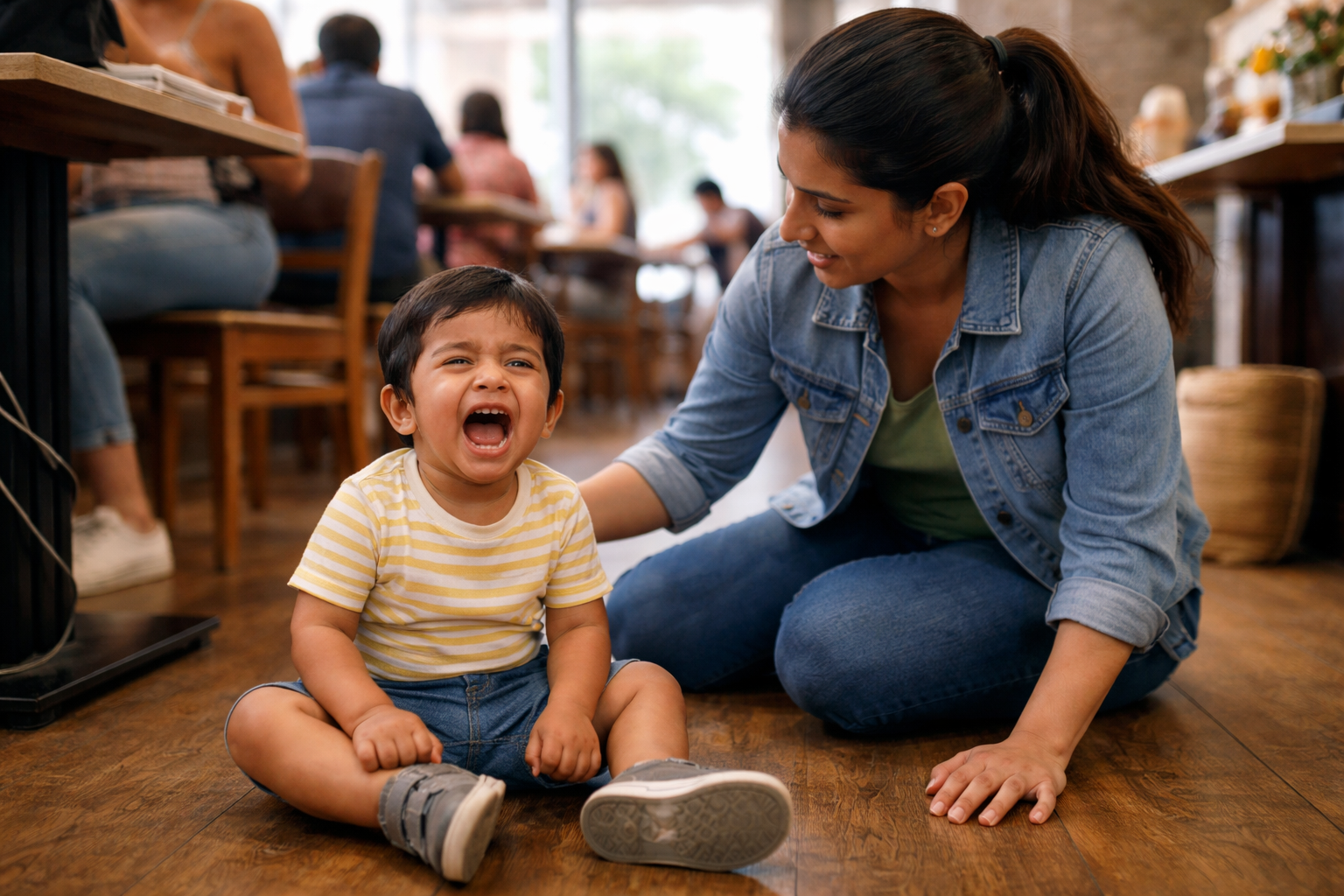
They will happen. A tantrum in a restaurant, at the airport, on the beach, in the hotel corridor at bedtime — it's not a question of if but when. Knowing that in advance reduces the emotional charge of the moment considerably.
Prevention is the most productive approach. The primary triggers are hunger, tiredness, and overstimulation — and all three are more likely on a holiday when routines shift. The rules: never skip a nap for an activity. Keep snacks permanently available. Give choices where possible ("red shoes or blue shoes?", "shall we have lunch here or walk to the other café?") — choice gives toddlers agency within a framework you control, and reduces the frequency of refusal-based tantrums significantly. Don't overschedule. One good thing per morning is enough; two things is pushing it; three guarantees a meltdown by lunchtime.
Management during a meltdown: get low (crouch down to their level), stay calm (your stress escalates theirs), and remove them from the situation if the environment is making it worse. Do not try to reason with a mid-tantrum 2-year-old. Reasoning doesn't work at this developmental stage when the emotional brain has completely taken over. What works is calm physical presence, a quiet voice, and time.
Recovery is fast at this age. A 2-year-old tantrum that felt catastrophic at its peak is typically over within 5 minutes, and they're running toward the next thing with no memory of it 10 minutes later. The adult recovery often takes longer than the child's. This is the developmental reality: the storm is intense and brief. Knowing it passes quickly makes it easier to ride out.
Sleep at 2 on Holiday
Most 2-year-olds are on one nap — post-lunch, usually 12:30–1pm, lasting 1–2 hours. Some are beginning to drop it entirely. If yours still naps, protect it as you would have protected the morning nap at 9 months. The difference between a well-rested 2-year-old in the afternoon and an overtired one is the difference between a good holiday afternoon and an unmanageable one. An afternoon activity can wait; the nap cannot be recovered once it's gone.
One important 2-year-old-specific challenge: travel cot climbing. Many 2-year-olds have figured out that travel cots are climbable and will demonstrate this at bedtime in the holiday cottage. If your child is a known climber, there are a few options: a travel bed guard rail fitted to the accommodation's bed (check before booking — some cottages have low-framed beds that work for this), a pop-up travel toddler bed, or a floor mattress with a familiar duvet. The Lullaby Trust guidance on safe sleep is worth reviewing for this transitional stage.
Bedtime at 2 is typically 7–7:30pm. Getting a toddler to sleep in an unfamiliar place is harder than a baby — they're more aware, more verbal about their feelings about the dark/the room/the unfamiliar ceiling — but they also respond to the same sleep cues used at home. Consistent routine (bath, milk, story, bed), all the usual associations, and a patient approach to settling. The routine on holiday guide covers the full approach to keeping sleep on track away from home.
Eating Out With a 2 Year Old
A 2-year-old can use a spoon (imperfectly), drink from an open cup (enthusiastically but chaotically), and has clear preferences about food. They are also unpredictable in a restaurant setting: the meal they ate happily four times last week may be refused with genuine disgust today. This is not stubbornness; it's normal toddler food neophobia and sensory development. Accept it and plan accordingly.
Restaurant strategies that work: choose places with outdoor seating or a garden where a mobile toddler causes less disruption. Order quickly when you sit down — the window of manageable waiting is short. Bring a backup snack (crackers, fruit) to bridge the gap between ordering and food arriving. Cut food into manageable pieces before it reaches the table if possible. Accept that some meals will be abandoned halfway through when the toddler decides they're finished — this is normal and not worth fighting.
A portable highchair remains genuinely useful at 2 — many venues' highchairs are sized and secured for smaller children, and a 2-year-old who can climb out of a restaurant highchair will do exactly that. Having your own that clips directly to the table gives you reliability. The Inglesina Fast Table Chair continues to work up to 15kg / around 3 years and is still worth packing.
A Sample Holiday Day With a 2 Year Old
| Time | Activity | Notes |
|---|---|---|
| 7:00–8:00am | Wake, breakfast at the cottage | Self-catering means breakfast on your schedule |
| 9:00–11:30am | Morning activity — beach, park, farm visit | One activity max. Snack at 10am. Leave before they're exhausted. |
| 12:00pm | Lunch | Keep it simple — cottage lunch or a quick café stop |
| 1:00–3:00pm | Nap | Protect this. Every other decision in the day is negotiable; this isn't. |
| 3:00–5:30pm | Afternoon activity — garden, short walk, playground | Lower-key than the morning. Snack at 3pm. |
| 5:30–6:30pm | Bath and dinner | Early dinner — a 2-year-old eating at 7pm is an overtired 2-year-old |
| 7:00–7:30pm | Bedtime routine | Consistent — same as at home. Story, milk, same order every night. |
| 7:30pm onwards | Adult time | Self-catering means you can have an actual evening. Use it. |
What to Pack Differently at 2
The packing list shifts meaningfully from baby travel. Items you no longer need: most baby-specific gear (steriliser, bottle warmer). Items that become more important: reins or a wrist link (still essential at 2 in busy environments — a 2-year-old near a road or a crowd is a different proposition to a baby in a carrier). Pull-ups if potty training has started — pack more than you think you'll need and factor in that accidents increase when routines shift and children are excited.
A comfort object is now critical in a way it may not have been at 9 months. Whatever your child is attached to — a specific toy, a blanket, a particular soft animal — do not leave it at home. It is the single item that most affects sleep in a new environment. Check it is in the bag. Then check again.
Entertainment packs for travel: a new sticker book, small figurines or toy cars, a simple puzzle, crayons and a pad. Introduce items one at a time rather than all at once — novelty extends engagement. For the complete toddler packing list, our baby holiday packing list covers what to add for this stage, and the holiday travel essentials guide has the full kit breakdown.

Bugaboo Butterfly — For the "I Won't Walk" Moments
A 2-year-old will confidently walk the full length of the beach in the morning and absolutely refuse to walk ten metres back to the car in the afternoon. A compact stroller you can fold one-handed (the other hand being occupied by a struggling toddler) earns its place enormously at this age. The Bugaboo Butterfly's one-motion fold and reasonable weight (around 6.4kg) make it the most practical compact stroller at the point where your toddler is simultaneously refusing to walk and refusing to sit in the buggy.
Pros: one-motion fold; reclines for naps; compact in the car boot; good canopy; handles airport gate-checking well.
Cons: premium price at around £500–£530; not designed for rough terrain. For the full range of travel pushchair options at different price points, see our reviews guide.
View on Amazon
Ergobaby Omni Breeze — Still Genuinely Useful at 2
A carrier at 2 might seem unnecessary — until the end of a long day when your toddler is overtired and the car park is still a 15-minute walk away. The Ergobaby Omni Breeze carries up to 20kg (most 2-year-olds are around 12–13kg) and the back carry position means the weight is on your hips rather than your arms. For beaches, cobbled streets, and any terrain where a stroller is impractical, it still does an excellent job at this age.
Pros: carries toddlers comfortably in back carry; ergonomic hip belt transfers weight well; breathable mesh; machine washable after sandy/muddy days.
Cons: getting a wriggly 2-year-old into a back carry requires practice — nail it before the holiday, not on the beach. Around £175–£185. See our carrier hub for all options.
View on Amazon✈️ Free Baby Hand Luggage Checklist
Never forget the essentials. Enter your email and we'll send the free checklist straight to your inbox — one page, every category, ready before every flight.
Frequently Asked Questions
What is the best type of holiday for a 2 year old?
Holiday parks (Centre Parcs, Haven) are the easiest win at this age — enclosed, traffic-free, with toddler pools, playgrounds, and entertainment tailored to this stage. Beach holidays are excellent for the simple reason that sand and water provide unlimited independent entertainment. Self-catering cottages with enclosed gardens give the space to run and the kitchen flexibility for routine management. City breaks work but require more careful pacing — one activity per morning maximum.
Do I need to buy a seat for my 2 year old on a plane?
On most airlines, yes — children aged 2 and over are required to have their own seat. The lap infant arrangement ends at the second birthday on the majority of airlines. Check your specific carrier's policy, as the exact cutoff varies slightly. A 2-year-old with their own seat is easier to manage than a lap toddler, so while the cost increases, the flight experience genuinely improves.
How do I manage tantrums on holiday?
Prevention first: never skip a nap for an activity, keep snacks permanently available, give choices to create toddler agency within your framework, and don't overschedule. During a meltdown: stay calm, get to their level, remove from the situation if needed, and don't attempt reasoning until it's passed. Recovery is fast at this age — within 5–10 minutes they're usually fine. The adult emotional recovery typically takes longer.
My 2 year old climbs out of the travel cot. What do I do?
This is common at this age. Options: a travel bed guard fitted to the accommodation's bed, a pop-up toddler travel bed, or a floor mattress with a familiar duvet. Check the accommodation before booking for what's feasible — some cottages have low-frame beds that work well with a guard rail. Follow Lullaby Trust guidance on the transition from cot to bed for this stage.
What entertainment should I pack for a 2 year old on a plane?
A tablet with downloaded (not streamed) content is genuinely effective for 20–30 minute stretches at this age. Back this up with a new sticker book, small figurines or toy cars, simple puzzles, and snacks. Introduce items one at a time for maximum novelty value. A window seat extends the free entertainment window during takeoff, landing, and cloud-watching significantly.
How do I keep a 2 year old's sleep routine on holiday?
Protect the post-lunch nap above everything else — it's the most important variable in afternoon and evening behaviour. Maintain the bedtime routine exactly as at home (bath, milk, story, same order). Bring all sleep cues: comfort object, white noise if you use it, blackout blind if the room isn't dark. Accept that the first night will be unsettled — most 2-year-olds adapt by night two. Our routine on holiday guide covers the full approach.
Is it worth taking a carrier for a 2 year old on holiday?
Yes — particularly for the end-of-day moments when they're overtired, refusing to walk, and the car is still far away. The back carry position in a structured carrier like the Ergobaby distributes the weight well for a toddler at this age (typically 12–13kg). It's also still useful for cobbled streets, beaches with soft sand, and anywhere the stroller isn't practical. Practice the back carry before the holiday.
What's the difference between travelling at 18 months vs 2 years?
Two years is generally more manageable than 18 months, which is considered the hardest travel age by many families. At 2, the communication gap is significantly smaller (they can express what they want), tantrums are slightly less frequent and shorter, and the range of effective entertainment expands (tablets, sticker books, imaginative play). The new challenge at 2 is the combination of mobility, strong opinions, and a paid airline seat. See our full 18-month travel guide for the direct comparison.
The Verdict: Holiday With a 2 Year Old
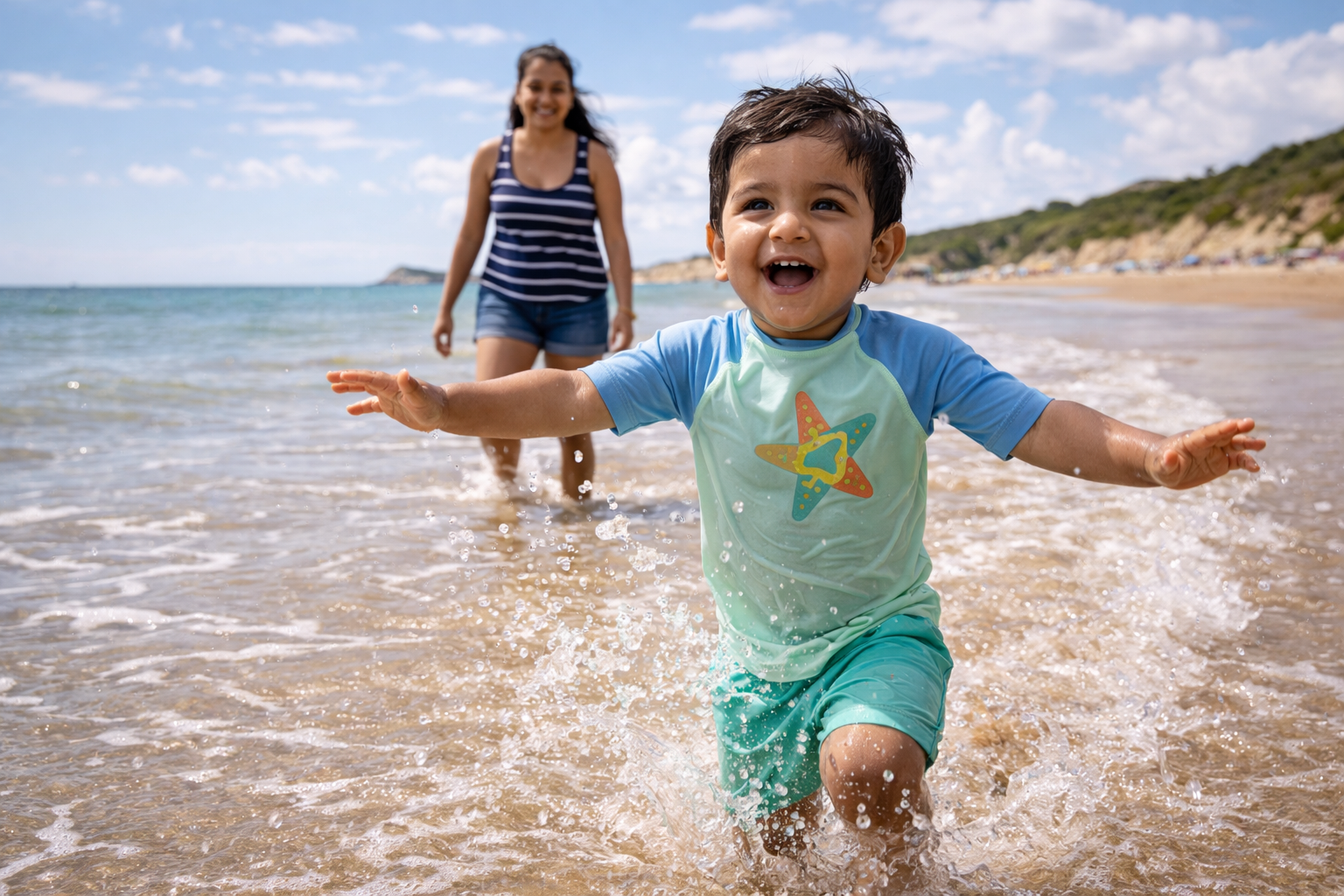
A holiday with a 2-year-old requires more active management than the baby trips that preceded it — but it rewards that management with something the earlier trips didn't: a small person who is genuinely excited about where they are, who will run into the sea with their arms outstretched and look back at you laughing, and who will talk about the trip for weeks afterwards. Protect the nap. Pack the snacks. Keep the days simple. Accept that some moments will be chaotic. The good ones — and there will be plenty — are the reason you go.