
Buggy Board vs Double Pushchair for Travel: Which Works Best?
By BabyTravel UK Editorial Team · Last updated September 2026
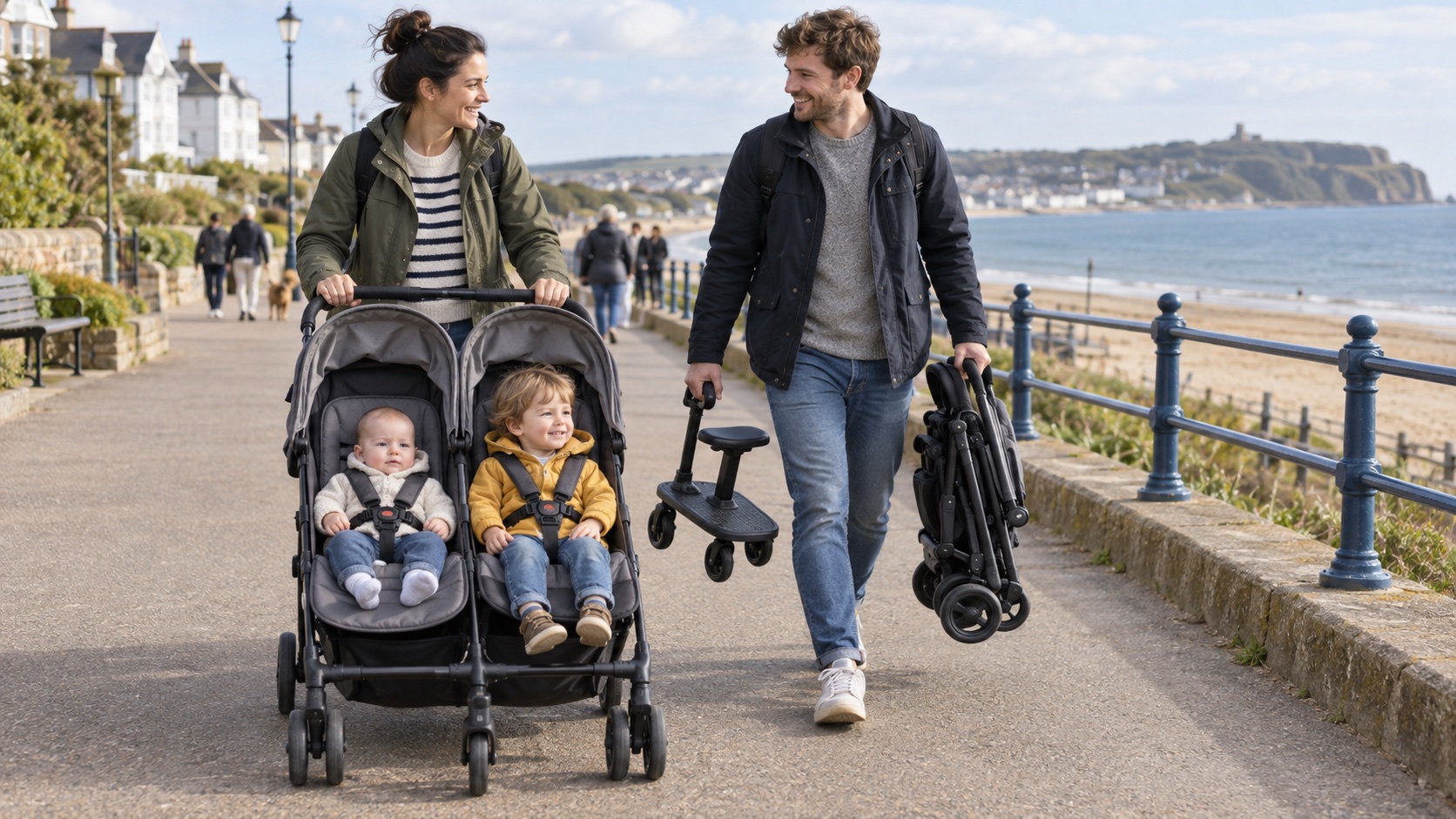
A buggy board keeps your luggage lighter. A double pushchair gives both children a secure seat. The difficult choice sits between those two facts, especially when an older toddler walks brilliantly one day and asks to be carried the next.
This comparison is specifically for holidays and long journeys: airports, stations, full sightseeing days and unfamiliar bedtime routines. For a wider discussion of different two-child setups, read our guide to travelling with a toddler and baby.
Quick answer
- Choose a buggy board when the older child is a confident walker, rarely naps in a pushchair and needs only short rests.
- Choose a double when both children need seats, the older one still naps, or you need reliable containment.
- For flying: a single plus detachable board is easier to carry, but a lightweight double can be calmer for long queues and connections.
- For city breaks: count the actual walking hours rather than the number of days.
- Test first: a board depends on the child agreeing to use it safely.
Buggy board and double pushchair compared
| Question | Single pushchair + board | Double pushchair |
|---|---|---|
| Both children can nap? | No | Usually, if both seats recline suitably |
| Easy to lift? | Usually lighter in separate pieces | Heavier and more awkward |
| Child contained? | Baby only; older child must cooperate | Both children can be harnessed |
| Airport handling? | Board should normally be detached | One large item, often gate-checked |
| Typical extra cost? | Roughly £50–£150 for a board | Often £200–£800+ for a double |
| Storage at destination? | Smaller | Needs more floor or boot space |
| Best age pattern? | Baby plus capable preschool walker | Twins, two young toddlers or a child who still needs a seat |
The age gap matters, but naps matter more
A child’s birthday does not tell you whether they can manage a board for a whole holiday. Two three-year-olds may have completely different stamina, road awareness and tolerance for standing. Start with what your child does on an ordinary long day, then make the travel plan slightly more generous.
Under about two, most children are not ready for a standing board and many boards are not approved for them. Between two and three, a board may work for brief trips but can be unreliable after a missed nap. From three onwards, it becomes more realistic if the child walks well and accepts instructions, although long sightseeing days can still overwhelm them.
If your older child sleeps in a pushchair more than occasionally, a board does not solve the main problem. A saddle lets them sit upright but is not a nap seat. A double with two usable reclines is worth the bulk when midday sleep determines whether the afternoon remains enjoyable.
When a buggy board is the better travel choice
📋 Free Baby Holiday Packing Checklist
Enter your email and we'll send the free printable checklist straight to your inbox — every category, ready to tick off before every trip.
A board suits a child who wants independence and usually walks, but needs a lift through a large terminal or back to the hotel. It keeps the baby’s existing single pushchair in use and can be detached when the older child is walking.
It works particularly well for train weekends, short city breaks and resort holidays where you can return to the room. The setup also fits smaller hire-car boots. Instead of loading a double chassis, you can split the stroller and board between available spaces.
Choose a board if most of these statements are true:
- Your older child walks for at least an hour with normal breaks.
- They no longer depend on a pushchair nap.
- They stay beside you in busy places and respond when asked to step off.
- Your single pushchair has an approved board fitting.
- You can walk naturally behind the fitted board.
- The itinerary allows food, toilet and play breaks.
Compare the current buggy-board options after checking these basics. Buying a saddle does not turn a poor board candidate into a good one.
When a double pushchair earns its space
A double is the more dependable option for twins, two children under roughly three, or any trip where both need to sit for long periods. It gives you two harnesses while you find passports, speak to staff or cross a busy road. That control can be more valuable than saving a few kilograms.
It also creates a reliable nap plan. Check that both seats recline in the configuration you will use, because some tandem seats have different age or recline limits. A side-by-side often gives both children similar seats but can be difficult in small lifts and narrow hotel corridors.
A double is more likely to be worth it if the holiday includes early flights, airport changes, theme parks, full sightseeing days or late dinners. These are exactly the situations in which a normally cheerful walker can become exhausted. Our double travel pushchair hub compares side-by-side and tandem choices.
Airports: lighter equipment versus calmer queues
The single-and-board setup is easier to divide. Detach the board, place its connectors in a zipped pouch and gate-check the pushchair. The disadvantage appears while everything is separated: one adult may be holding a baby, folding the buggy, managing luggage and keeping the older child beside them.
A double keeps both children seated until staff take it, provided the airline and airport allow gate use. It then becomes one bulky item that may return at oversized baggage rather than the aircraft door. You need a carrier or walking plan for the route from the plane to reclaim.
Ask the airline whether a detachable board is included in its free child-equipment allowance. Do not assume staff will accept loose wheels and saddles as part of one pushchair. Check our gate-checking guide and remove every unsecured accessory before handover.
City breaks: calculate distance and surfaces
A sightseeing day can easily involve 15,000 adult steps, much of it on paving, station corridors and museum floors. A preschooler’s shorter legs cover more steps over the same route. If the day begins after an early flight and ends after dinner, a board that works on the school run may not be enough.
Boards roll best on smooth ground. Cobbles, high kerbs and broken pavements create repeated points where the child must step off. A double with larger wheels handles those surfaces better, although its width can be troublesome in old buildings. Read our guide to pushchairs for cobbles and uneven ground if the destination has historic streets.
Plan around the hardest two-hour section, not the easiest morning. If you cannot return to the accommodation and the older child may sleep, take the double or arrange a realistic carrier swap between adults.
Public transport in the UK
A single pushchair is easier on buses and narrow train aisles, but the board needs to fold up so it does not obstruct other passengers. Your child must step off before boarding and remain close while you lift or fold the buggy.
A lightweight side-by-side can fit many accessible spaces but may need to be folded if the space is required by a wheelchair user. A tandem is narrower, though often longer to turn. Whichever option you use, keep bags out of the basket if you might need a quick fold. Our UK train guide for parents covers station assistance and boarding.
Cost: compare the complete setup
A universal board can cost around £50–£90, while a seated or branded board may be around £100–£150. Add any adaptor, extender and travel bag. If your current pushchair is compatible and comfortable, this is still much less than a new double.
A lightweight double commonly starts around £200 and premium models can exceed £700 before accessories. It may hold value for resale and can be used daily, so divide the cost by the number of months it will genuinely serve both children. Hiring at the destination can make sense for a one-off theme-park holiday.
Do not buy a cheap board that fits badly. Kicking it on every step or removing it for every fold can lead to buying the double afterwards. Equally, do not buy a large double for one anxious flight if the older child has comfortably stopped using a pushchair.
One adult travelling with two children
Solo travel changes the answer. A board rider is not harnessed and can step off while you deal with tickets or the baby. A double offers containment, but you must be physically able to fold and lift it without another adult.
Practise the airport-security routine at home. Place the baby in a carrier, ask the older child to hold a fixed point or your clothing, then fold the stroller and manage the trays. If the double cannot be folded while you supervise both children, its theoretical convenience disappears.
Choose the arrangement with the fewest moments that require three hands. For some families that is a compact single, carrier and board. For others it is a light double kept open for as long as staff permit.
A simple pre-holiday trial
Load the changing bag as you would for travel and take a two- or three-hour local outing at the same time of day as your hardest planned excursion. Include a bus, stairs or busy shopping area if those will feature on the trip.
Notice when the older child asks to ride, how long they remain on the board, whether they try to sit incorrectly and whether you can still use the brake. With a double, test doorways, kerbs, folding and loading into the boot. One realistic rehearsal is more useful than a dozen product videos.
If the trial only works because one adult carries the older child, count that honestly. Holiday heat, delays and luggage normally make the same task harder.
What to pack for either setup
For a board, pack the correct release tool, a small pouch for connectors and a photograph of the fitted arms. For a double, take the raincover sections, wheel covers and a bag large enough for gate-checking. Label every detachable part with your contact details.
Both setups benefit from a lightweight carrier. It gives you somewhere safe for the baby while a pushchair is folded at security or carried up stairs. Keep nappies, passports and medicines in a backpack rather than the basket, because transport staff can ask you to collapse the pushchair with little warning.
✈️ Free Baby Hand Luggage Checklist
Never forget the essentials. Enter your email and we'll send the free checklist straight to your inbox — one page, every category, ready before every flight.
FAQ
Can a buggy board replace a double pushchair?
Yes, when the older child walks well, follows instructions and no longer needs a pushchair nap. It is not an equivalent replacement for a younger toddler who needs a harnessed seat.
What age gap works best with a buggy board?
There is no fixed gap, but baby plus confident preschooler is the usual pattern. Follow the board’s minimum age and weight limits, then judge your own child’s balance and stamina.
Is a sit-down buggy board as good as a second seat?
No. It gives an upright resting perch but normally has no recline or full pushchair harness. It suits short rests, not naps or dependable containment.
Are double pushchairs free to take on planes?
Many airlines carry a pushchair as free child equipment, but size, weight and number-of-item rules vary. Check the current policy for every carrier in your itinerary.
What if my toddler refuses the buggy board?
Do not rely on it for the holiday. Try several low-pressure local outings; if they repeatedly step off or sit incorrectly, choose a double or change the itinerary.
Which is easier on trains?
A single plus lifted board is usually easier through narrow aisles and lifts. A double can still be preferable when both children need seats and you reserve assistance for boarding.
Can I use a carrier instead of either option?
A carrier plus single stroller can work when one child is within the carrier’s limits and an adult is comfortable carrying them. Heat, back comfort and long nap periods need planning.
Should I buy a double for one holiday?
Only if the itinerary genuinely needs two seats. Consider borrowing, hiring or buying second-hand if normal life after the trip will not use a double.
Our verdict
Choose the buggy board when your older child already behaves like a walker who occasionally needs help. Choose the double when the trip still demands two proper seats. The best answer is the one that works during the tired final hour, not just the easy first hour after breakfast.